
By: Mark G. Feathers, Environmental Engineer, Lead United States Aviation and Missile Command (AMCOM)-G4, Scott Howison, Physical Scientist, United States Army Aviation and Missile Command (AMCOM)-G4, Jasmine Briant, Physical Scientist, United States Army Aviation and Missile Command (AMCOM)-G4, Ted Ventresca, CHEMEON President/ COO
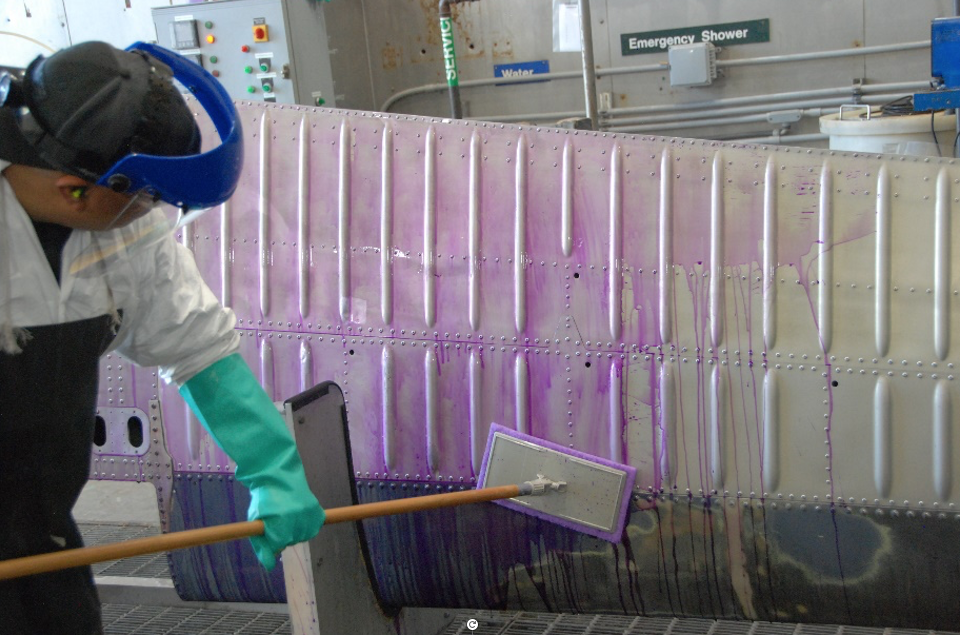
Image: Application of CHEMEON eTCP to a UH-60 Stabilator at Corpus Christi Army Depot (CCAD)
In the expansive hangars of Corpus Christi Army Depot, the process lines of Letterkenny Army Depot and multiple field-maintenance locations, the U.S. Army is rewriting the rules of aviation and missile maintenance.
The familiar brown conversion coatings — long associated with aircraft like the AH-64 Apache and UH-60 Black Hawk — are being phased out. This strategic shift is more than cosmetic. It’s part of a broader initiative led by the U.S. Army Aviation and Missile Command (AMCOM) Heavy Metals Working Group to eliminate hexavalent chromium (Cr6+), a known carcinogen, and transition to safer alternatives across Army aviation platforms.
The efforts of AMCOM’s Heavy Metals Working Group involve years of testing alternatives to existing hex-chrome materials. Recently, a newly patented next-gen solution called eTCP, came onto the radar of AMCOM and under the review of the Heavy Metals Working Group. To trace the path of how a new innovation like eTCP is validated as a solution to replace a legacy military workhorse like hex chrome, you need to look back nearly 100 years.
A Corrosion Fighter with Consequences
Beginning with initial testing of chromates for corrosion protection in the 1930s, the full integration of hexavalent chrome into military applications likely started as early as 1941, when wartime production ramped up, and the need for effective corrosion protection became critical for maintaining equipment in harsh environments. Cr6+ has been the Army’s standard corrosion inhibitor. Integrated into paints, primers, conversion coatings and sealants, hexavalent chromium offered unmatched protection in extreme environments — from salt-laden coastal air to abrasive desert dust.
These materials enabled legacy aircraft, weapons and vehicles to remain operational far beyond their original service lives. But this durability has come at a significant cost. Cr6+ is a toxic heavy metal that poses severe risks to personnel and the environment. Recognizing this, the Department of Defense issued Directive 5000.01 to minimize environmental and occupational hazards. Army Acquisition Policy followed, explicitly targeting Cr6+ for elimination in production, maintenance and sustainment activities.
The Challenge of Legacy Specifications
Transitioning away from Cr6+ is not as simple as swapping one material for another. Many military platforms remain tethered to outdated technical data packages (TDPs) and specifications requiring Type I hexavalent chrome coatings under MIL-DTL-81706. Unless updated by OEMs or the DoD, these requirements remain binding for depots, field repair stations and MRO contractors.
Even where alternatives exist, few match Cr6+ one-for-one in performance — particularly in corrosion resistance, adhesion and long-term durability. This has made the transition both technically and administratively complex. Additionally, a significant amount of testing is required to ensure performance requirements are not compromised with the non-Cr6+ alternative.
“Army researchers continue to develop and test viable coatings, adhesives and sealants alternatives that will ultimately be approved for use on Army weapons systems. As we progress, our processes and materials will change, and the requirement for personal protective equipment will diminish as we incorporate our advancements into our current and future facilities,” Feathers says in a 2020 AMCOM Finishing and Coating article https://finishingandcoating.com/index.php/liquid-coat/213-u-s-army-reducing-heavy-metal-exposure-in-military-paints
The financial burden is also significant. The Army invested $3 million at Corpus Christi Army Depot in mitigation systems, including HEPA filtration and vacuum units. At Fort Drum, a single hangar decontamination project cost $250,000. These investments aim to reduce exposure, but the root issue remains: Cr6+ is still widely used. Personnel working with hex chrome face elevated risks of respiratory illness and cancer, monitored through ongoing medical surveillance programs.
A 60+ Member Coalition Leading the Charge
To address this challenge, AMCOM formed the Heavy Metals Working Group — a coalition of over 60 subject-matter experts from across the Army’s engineering, environmental and logistics directorates. Led by figures such as Mark Feathers, AMCOM G-4 Lead Project Manager, and Scott Howison, AMCOM Physical Scientist, the group has spearheaded the Army’s Cr6+ elimination effort.
Their dual mission: protect personnel and sustain mission readiness.
Mark notes that “It was recognized early that protection of our people and sustainability of our maintenance processes required the elimination of hexavalent chromium. This led to our efforts to develop 15 different processes for both depot and field maintenance operations to mitigate the impacts of hexavalent chromium.”
By the end of 2019, the group had mapped every AMCOM site with known exposure risks — not only from Cr6+, but also cadmium, lead and beryllium — and prioritized strategies to develop alternatives based on exposure risk and mission impact.
Mark went on to state that “Aluminum conversion coatings, being very pervasive in our processes, became a very high priority for replacement since the risk exists while applying and removing this coating.”
Partnerships Driving Change
AMCOM’s Heavy Metals Working Group doesn’t work in isolation. It collaborates closely with the Combat Capabilities Development Command Aviation and Missile Center, and the Army Research Laboratory to test, validate and transition viable alternatives into production. It also collaborates closely with partners at NAVAIR and the Air Force to share technological developments for the mutual benefit of the DoD industrial base.
The Army Contracting Command and resource managers help align funding and update contractual requirements, while technical leaders ensure that validated materials are qualified under relevant MIL-specs.
One such material class is Type II trivalent chromium conversion coatings — CrVI -free alternatives approved under MIL-DTL-81706B and MIL-DTL-5541F for brush/wipe, spray, immersion and touch-up applications. These coatings are listed on the Qualified Products Database (QPD) and represent a new generation of solutions offering comparable corrosion resistance without the toxic burden of Cr6+.
Among these, eTCP — a patented Type II trivalent chromium product — provides a distinct violet color indicator, allowing visual verification that a part is coated. This color serves as a subtle nod to the legacy brown of hex chrome, while signaling a safer path forward.
ccording to Scott Howison, “We recognized that a technological advance in the chemistry of conversion coatings of aluminum had occurred under a Navy NESDI project and the result was the development of eTCP. It only made sense to partner with our Navy colleagues for a cross-service solution that could provide benefits to sustainability and readiness across the defense industrial base.”
The Army communicates validated materials like eTCP to the broader maintenance and repair community through depot and field maintenance documentation like Aviation Maintenance Action Messages (AMAMs). These channels ensure that depots, field repair teams, OEMs and coating facilities receive timely updates and implementation guidance.
Scott added that “Many factors are carefully considered in the rollout of a new technology like eTCP for use by artisans and field maintainers. Our objective is to ensure the smoothest implementation possible by provisioning the supply chain to handle increased demand, training the workforce, and then providing ongoing support to maintainers and warfighters as they begin to use the new technology to protect our assets.”
Shedding a Chemical Legacy
As Type II conversion coatings are implemented at depots and field repair stations, the Army is not merely replacing a material — it is retiring a chemical legacy. This marks a turning point: proving that innovation in materials science can safeguard both mission readiness and human health. “The diligence of AMCOM’s Heavy Metal Working Group to identify, test and validate solutions like our chemistry ensure the Army’s aviation fleet remains ready to protect on air, land and sea with a safer environmental solution that also protects the coatings applicators at the OEM, shop, field repair and front line,” said Ted Ventresca, President and Chief Operating Officer of CHEMEON Surface technology. eTCP is now available globally through the Defense Logistics Agency (DLA).
FREQUENTLY ASKED QUESTIONS
What is AMCOM doing about hexavalent chromium?
The U.S. Army Aviation and Missile Command (AMCOM) is actively leading efforts to replace Cr(VI) with safer alternatives while maintaining mission-critical performance. CHEMEON is a key industry partner in this transition.
Which military entities does CHEMEON work with on trivalent chromium?
CHEMEON collaborates with AMCOM, Naval Air Warfare Center (NAVAIR), Army Missile Command, U.S. Marines, NASA and the world’s largest primes and OEMs on qualification, testing, and implementation of eTCP®, TCP-HF (Hex Free) and ECC-PRO (Electrolytic Convrsion Coating Process) solutions.
Are CHEMEON trivalent coatings MIL-DTL qualified?
Yes — both eTCP® and TCP-HF are listed on QPL-81706 for MIL-DTL-81706 B and MIL-DTL-5541F Type II, Class 1A and Class 3 applications. The ECC-PRO, electrolytic conversion coating process is an anticipated addition to the upcoming MIL-DTL 81706 Rev C.
How do CHEMEON solutions compare to hexavalent chrome?
They are the Safe, non carcinogenic alternative that provides comparable or better corrosion protection and adhesion in many applications while eliminating the health and environmental hazards associated with Cr(VI).
Can CHEMEON help my organization transition from hexavalent chrome?
Absolutely. We offer expert technical consultation, samples, training, 3D metrology validation, and specification support.
What is Dr. Sjon Westre’s role in trivalent chromium development?
As CTO, Dr. Westre was the first to commercialize the Navy TCP as TCP-HF (Hex Free) and is the co-inventor of the patented eTCP with the consistent superior performance on 2024 aluminum and the signature purple/violet colorization for QC/QA that parts are coated and protected. Dr. Westre continues to lead CHEMEON’s innovation in this critical area.
Are there training programs for trivalent chromium implementation?
Yes — our hands-on classes cover best practices for TCP-HF, eTCP®, and related processes like ECC-PRO, with strong focus on mission critical military and OEM-spec applications.
How does 3D metrology support the transition to trivalent coatings?
CHEMEON’s Keyence VK-X3000 provides quantitative data on coating uniformity and surface condition to validate performance during qualification and production.
Who can benefit from CHEMEON’s trivalent chromium solutions?
Aerospace primes, OEMs, defense contractors, MRO facilities, and any organization seeking safer, high-performance alternatives to hexavalent chrome.
How do I get started with CHEMEON trivalent coatings?
Contact us info@chemeon.com for samples, a consultation with our technical team, or to discuss your specific AMCOM or military requirements.
Are CHEMEON products available through NSN / DLA, and how can global military partners in the US and Europe access them?
Yes — many CHEMEON products, including eTCP® and TCP-HF (Hex Free) trivalent chromium conversion coatings, are available through the Defense Logistics Agency (DLA) via National Stock Numbers (NSN). This provides streamlined procurement for U.S. military and authorized partners.
For global military partners:
- United States: Direct access through DLA, primes, and authorized distributors with NSN support for qualified products.
- Europe and International: Availability through our authorized international distributor/resellers, enabling efficient supply to NATO and allied forces. CHEMEON maintains strong compliance with MIL-DTL, REACH and other international standards to support global defense and environmental programs.
Our team can assist with tailored procurement solutions. Contact us directly info@chemeon.com for current NSN listings, availability, or to discuss your specific military or international requirements. Dr. Sjon Westre and the technical team are available for technical discussions on compliance and application.